4D generation asks a model to create a scene across time and viewpoint at once. The result is not one image or one fixed-camera video, but a dynamic object that remains recognizable as both the object and the camera move.
That makes 4D generation a natural visual layer for world models and physical AI. It also makes inference expensive. A model must repeatedly preserve shape, texture, camera consistency, and motion consistency over a large grid of frames and views.
Turbo4DGen is built around a simple question: how much of that work is genuinely new?
The bottleneck is an attention chain
SV4D, the baseline used in our paper, aligns a generated scene along three axes. Spatial attention preserves image detail. Camera attention keeps the object coherent across viewpoints. Motion attention keeps movement continuous across frames. Together they form the spatial-camera-motion (SCM) attention chain.
Shape, texture, and detail inside each frame.
Identity and geometry across different views.
Continuous behavior across generated frames.
The chain is effective, but it dominates latency and memory. In a diffusion model it also runs again and again over many denoising steps. Our analysis found that outputs from adjacent SCM attention steps often have cosine similarity above 95%, especially later in generation. The model is spending much of its time rediscovering a representation it already has.
Existing shortcuts do not transfer cleanly. Caching an entire network block ignores the SCM chain’s internal connections. Pruning each attention block independently can break the spatial, camera, and motion consistency that 4D generation depends on. A useful accelerator has to understand the structure of the chain.
Three interventions, one pipeline
Turbo4DGen removes redundancy at three different scales. Each mechanism answers a different question: what can be reused, which tokens deserve fresh computation, and when can a whole chain be skipped?
Keep a rolling cache for each SCM block and reuse stable attention outputs at the next denoising step.
Use spatial attention to select semantically important tokens; refill pruned positions from cache instead of with zeros.
Track inter-step similarity and bypass intermediate SCM chains only after the denoising representation becomes stable.
Reuse what has not changed
The rolling cache stores spatial, camera, and motion attention outputs independently. At the next denoising step, stable outputs can be retrieved without recomputing the corresponding attention operation. Cached features are released sequentially, so reuse does not require the model to keep every past representation in memory.
Spend new compute on the object
Not every location contributes equally to the generated subject. Turbo4DGen reads semantic importance from the spatial cross-attention map and uses it to select tokens for the more expensive camera and motion blocks.
Naive pruning fills removed locations with a constant such as zero, which can introduce visible artifacts. Turbo4DGen fills them with the corresponding values from its rolling cache. Fresh computation goes to the important regions while the rest of the representation stays coherent.
Skip only after the scene stabilizes
Redundancy changes over the course of diffusion. Early steps make large structural decisions; later steps refine an increasingly stable scene. A fixed skip schedule can therefore remove important work too early.
Turbo4DGen instead tracks average similarity across the rolling cache. Once that signal crosses a threshold, the scheduler routes features through only the first and last SCM chains and bypasses the intermediate chains. The schedule follows the sample rather than a hard-coded timestep.
What the measurements show
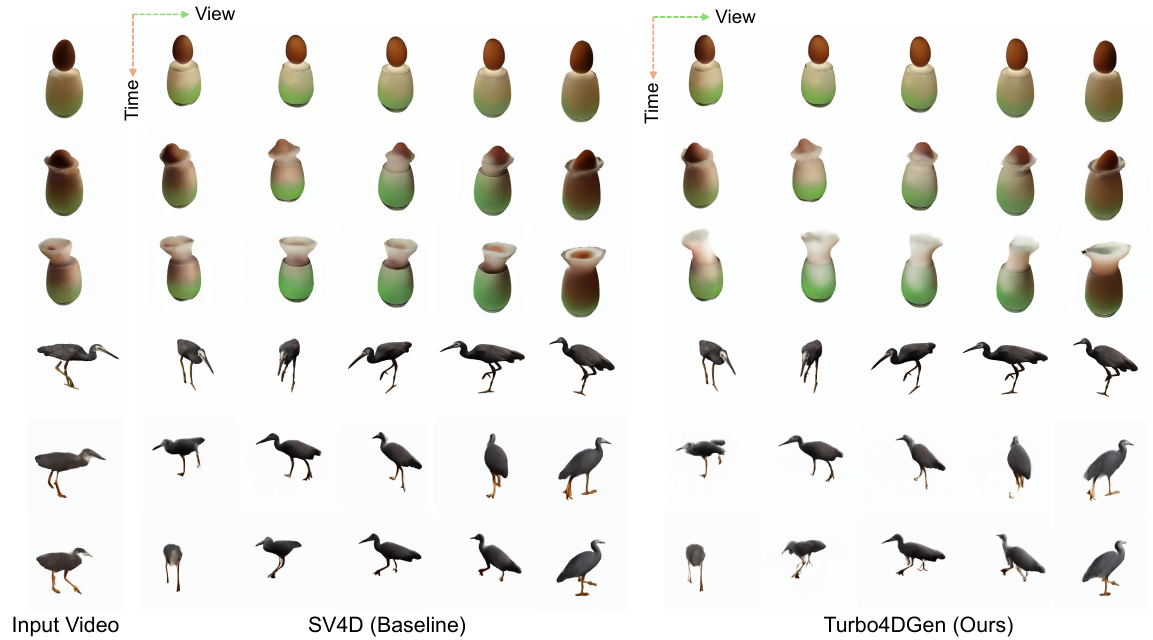
We evaluate Turbo4DGen on ObjaverseDy and Consistent4D with SV4D as the primary baseline. The two visual examples above move from roughly two minutes to about ten seconds.
The advantage also holds as the generated clip grows. With the number of views fixed at eight, the measured speedup rises from 8.7x at five frames to 9.7x at twenty frames. At thirty frames, the SV4D baseline no longer completes because it runs out of memory, while Turbo4DGen still does.
The quality results are not a speed-only story. On ObjaverseDy, Turbo4DGen matches or improves SV4D on the five headline metrics reported below.
The zero-shot Consistent4D results are more mixed and should be read that way. Turbo4DGen is slightly behind SV4D on LPIPS, while improving CLIP Score and FVD-F. The strongest claim is not that acceleration improves every metric on every dataset. It is that a large efficiency gain can be achieved while visual quality remains broadly comparable.
| Method | LPIPS ↓ | CLIP-S ↑ | FVD-F ↓ |
|---|---|---|---|
| SV4D | 0.118 | 0.92 | 732.40 |
| Turbo4DGen 9.7x | 0.119 | 0.93 | 708.51 |
Memory is part of the result, not a footnote. At 30 frames and eight views, SV4D and the adapted DeepCache baseline run out of memory; Turbo4DGen completes the workload. For finite GPU budgets, crossing the line from “cannot run” to “runs” is often more useful than a small benchmark gain.
Where the 9.7x comes from
The ablation results expose the speed–quality role of each mechanism. Removing caching leaves quality strong but limits acceleration to 2.28x. Removing pruning reaches 11.74x, but LPIPS and PSNR both deteriorate. The complete system combines the two at a better operating point.
| Method | Speedup ↑ | LPIPS ↓ | PSNR ↑ |
|---|---|---|---|
| SV4D baseline | 1.00x | 0.122 | 18.47 |
| Turbo4DGen w/o caching | 2.28x | 0.106 | 22.86 |
| Turbo4DGen w/o pruning | 11.74x | 0.144 | 17.18 |
| Turbo4DGen | 9.70x | 0.113 | 20.27 |
Choosing when to bypass
The chain-bypass threshold controls when Turbo4DGen decides that the denoising representation is stable enough to skip intermediate SCM chains. A lower threshold starts bypassing earlier and runs faster, but quality falls sharply. The default α = 0.90 sits near the bend in both curves: most of the quality has been recovered while the system still retains a 9.7x speedup.
Speedup higher is better
PSNR higher is better
| Threshold α | Speedup ↑ | PSNR ↑ | CLIP-S ↑ | SSIM ↑ |
|---|---|---|---|---|
| 0.80 | 12.11x | 15.31 | 0.838 | 0.824 |
| 0.85 | 11.73x | 17.81 | 0.863 | 0.855 |
| 0.90 default | 9.70x | 20.27 | 0.917 | 0.891 |
| 0.95 | 9.56x | 20.29 | 0.919 | 0.893 |
Why this matters for physical AI
An embodied system must reason about objects and environments as they change over time and as they appear from different viewpoints. Static images cannot supply that representation on their own. Faster 4D generation can make three parts of the development loop more practical:
- More synthetic experience per GPU hour. Dynamic multi-view data can support perception training, augmentation, and evaluation when real capture is expensive or incomplete.
- Faster iteration on domain-specific world models. Lower latency makes it cheaper to compare checkpoints, inspect failures, generate targeted scenarios, and repeat the loop as new data arrives.
- A step toward interactive simulation. Seconds are not real time, but they support a much tighter loop than minutes and make larger evaluation suites operationally realistic.
Turbo4DGen is not itself a post-training algorithm. Its contribution is infrastructural: less expensive generation can lower the cost of producing rollouts, curating synthetic experience, and evaluating model updates.
The boundary: visual worlds are not physical worlds
Turbo4DGen should not be confused with a robotics simulator or an action-conditioned world model. The paper evaluates dynamic multi-view visual generation. It does not demonstrate contact dynamics, causal action prediction, policy learning, or robot control.
Those capabilities need additional ingredients: action conditioning, physically grounded dynamics, state estimation, safety constraints, and a reliable connection to real sensors and actuators. Turbo4DGen advances one layer of that stack by making coherent dynamic visual worlds much cheaper to generate.
The bottom line
Making world models practical is not only a question of training a larger model. It is also a systems problem: identify what the model recomputes, decide where new information actually appears, and stop paying for work that no longer changes the result.
Turbo4DGen applies that principle at three scales — reusing stable blocks, focusing on important tokens, and bypassing redundant chains. The result moves 4D generation from minutes toward seconds while reducing memory pressure and preserving broadly comparable visual quality.
Citation
Please cite our original paper as:
@inproceedings{man2026turbo4dgen,
  title     = {Turbo4DGen: Ultra-Fast Acceleration for 4D Generation},
  author    = {Man, Yuanbin and Huang, Ying and Ren, Zhile and Yin, Miao},
  booktitle = {Proceedings of the International Conference on Machine Learning (ICML)},
  year      = {2026}
}